
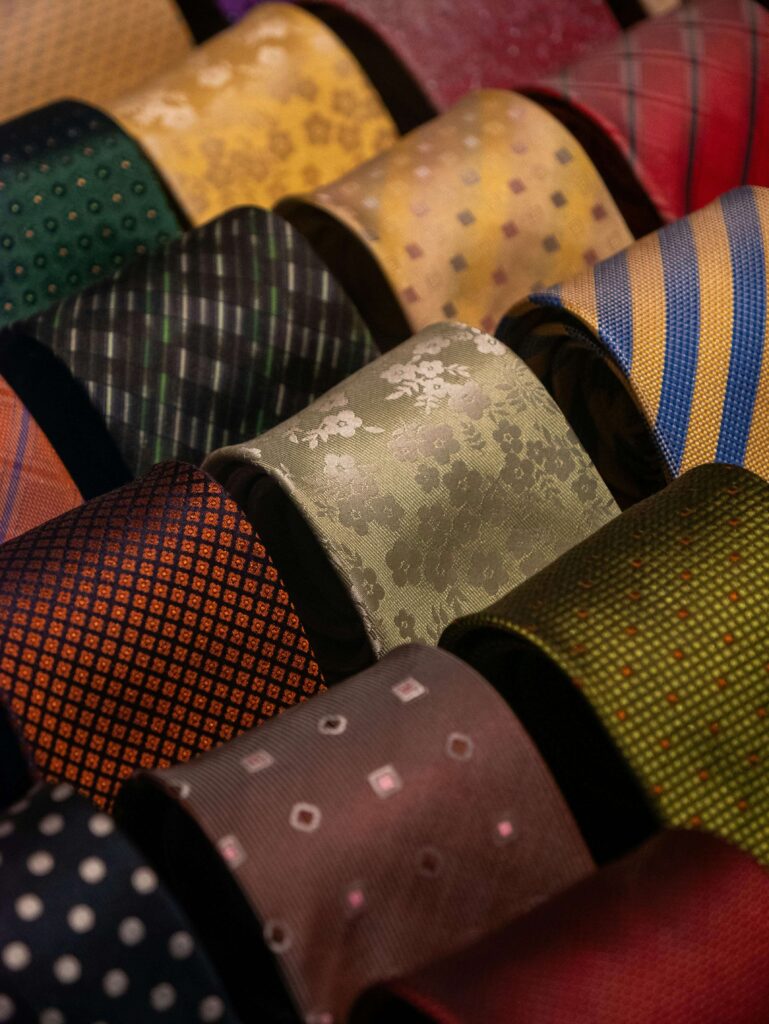
There’s a moment most organisations hit when they start designing a custom tie: the artwork looks perfect on screen, but the finished tie doesn’t always match the brief. A stripe can soften. A crest can lose definition. Colours can look slightly different once they’re in fabric, not pixels.
The reason is simple: “custom tie” isn’t one product. The method- woven, printed, or silk, changes how your design is translated, how it wears, and how premium it looks in real life. This guide breaks down what each option is best at, and how to choose the right one for your design.
(Quick note: “silk” is a material, while “woven” and “printed” are production methods. In practice, you’ll often be choosing a combination- like a woven silk tie or a printed tie on a different base fabric.)
Here is a quick rule-of-thumb before the details:
- Choose woven if your design is stripe-led, needs texture, and you want long-lasting colour and a premium feel. Woven ties use techniques like jacquard weaving where the design is created by the yarns themselves, not added on top.
- Choose printed if your design has lots of fine detail, gradients, or photo-like elements that weaving can’t reproduce cleanly. Printed ties are typically produced via screen printing or digital printing methods.
- Choose silk if the brief is “make it feel premium”. Silk is the classic choice for formalwear and branded ties when you want a richer drape and a more refined finish (and the weight/quality can vary depending on the silk).
What “woven” custom ties actually mean (and why they look premium)
A woven tie is built from the pattern up. Instead of applying ink to the surface, the design is created during weaving. Many manufacturers use jacquard weaving for this because it allows structured patterns and clean, repeatable designs.
What you’ll notice in the real world:
- Texture and depth. Woven designs tend to have a slightly raised feel or a visible structure in the weave.
- Durability. Because the design is part of the fabric, it typically wears better than a surface print over time.
- A “proper tie” look. Woven ties often feel a bit heavier and more traditional, which is why they’re common for clubs, schools, regiments and corporate uniforms.
Best for designs like:
- Classic diagonal stripes (club/school style)
- Repeat patterns (small motifs)
- Simple crests or logos that don’t require tiny line-work
- Two–six colour designs that need to stay crisp
When woven might not be ideal:
- If you need photographic detail, gradients, or very fine artwork
- If your logo includes lots of tiny elements that must be perfectly legible at small size
What “printed” custom ties are best at (and where they can fall short)
Printed ties take a base fabric and apply the design on top via printing. Depending on the supplier and the artwork, this can be screen printed or digitally printed.
Why people choose printed:
- Detail freedom. Printed ties are often the best way to handle complex logos, detailed crests, intricate illustrations, or multi-colour artwork that would be difficult to weave cleanly.
- Sharper fine lines. If you need a thin outline or small text (where appropriate), printing generally handles it better than weaving.
Trade-offs to consider:
- Flatter finish. Printed designs tend to sit “on” the fabric rather than being formed by it, so they may look less textured.
- Wear over time. Depending on print method and use, printed ties can fade more noticeably than woven designs, because the colour is applied to the surface.
Best for designs like:
- Detailed crests with fine elements
- Illustrations, gradients, shading
- Large, bold graphic designs
- Modern patterns where “flat colour” is part of the look
Where silk fits in (and what “momme” has to do with it)
Silk is often chosen for one reason: it feels premium.
But silk isn’t one single thing. Silk fabrics vary in weave (twill, satin, etc.) and in weight. A common way to describe silk weight is momme (often written as “mm”), which is a traditional measure of silk density/weight- higher momme generally means a denser, heavier silk.
What that means for custom ties:
- A higher-quality silk can give your tie more body, a better drape, and a more luxurious hand-feel.
- Silk can work well for both woven and printed ties- mit’s not either/or.
When silk is the right call:
- Corporate branding where the tie is part of an “impression” (events, hospitality, client-facing roles)
- Club ties where tradition matters
- Gift or premium merchandise ranges
When silk might not be necessary:
- If the tie is mainly functional (e.g., daily school use) and you want a lower-maintenance, budget-conscious option
Choosing based on your design
Here’s a simple way to match the method to what you’re designing.
If your design is mostly stripes…
Go woven. Stripes are what weaving does best: clean edges, traditional finish, and long-term wear.
If your crest/logo is detailed…
Consider printed, especially if it includes fine line-work or subtle colour transitions. Printing methods are commonly used for intricate artwork.
If you want the tie to feel “premium” even with a simple design…
Go silk (often combined with weaving). A simple stripe can look noticeably more refined on a quality silk base.
If you’re producing uniforms and longevity matters…
Lean woven. Woven designs tend to be harder-wearing because the pattern is integrated into the fabric.
If you’re unsure…
A lot of manufacturers will recommend the fabric and method based on “costs, purpose, quality and design”- because the best choice depends on what you’re trying to achieve.
Questions a manufacturer will ask (and you can prepare now)
To get to the right option quickly, have answers for:
- Who will wear the ties (supporters, staff, students, members)?
- How often will they be worn?
- Is the design stripe-led or logo-led?
- Do you need exact colour matching?
- Is this a premium piece, a uniform item, or a fundraiser product?
This mirrors how experienced suppliers approach custom tie design: not “what looks nice in a mock-up”, but what works in real life.
